Every technical founder eventually stares at a spreadsheet that makes no sense. You look at your engineering payroll. You see an iOS team, an Android team, and a Windows desktop team all building the exact same application.
You pay three different groups of engineers to solve the same business problems in three different languages.
Your product roadmap stalls because keeping those three codebases in sync requires constant supervision. Every new feature takes three times as long to ship. Every bug fix requires three separate pull requests.
I see businesses bleed cash this way constantly. You can fix this structural inefficiency when you maui developers who understand how to unify a fractured software ecosystem. You buy back your engineering bandwidth.
You stop managing cross-platform parity boards. You start shipping actual value to your users.
Building enterprise software requires a specific architecture. You cannot afford to string together a bunch of community plugins and hope they survive the next OS update. You need a foundation built for heavy data loads, native hardware integration, and long-term security compliance.
Let me walk you through the operational realities of migrating to a single C# codebase.
The Real Cost of Fragmentation in Enterprise Software
Software agencies love fractured codebases. Fragmented platforms guarantee endless billable hours.
They will gladly charge you for dedicated Swift and Kotlin engineers. They will nod and smile when you ask them to build a React web wrapper for your desktop users. They profit directly from your technical debt.
Operating a modern business demands efficiency. You cannot waste capital maintaining duplicate logic for data validation, API integration, and offline synchronization across three different code repositories.
When an enterprise client brings me in to audit their mobile strategy, I look straight at their QA budget. Fragmented teams require massive QA overhead. A bug that surfaces on Android might not exist on iOS, but your QA team has to test both platforms exhaustively just to be sure.
This is exactly where .NET MAUI app development services change the financial math. You write your core business logic once in C#. You define your data models once. You write your API connection layers once.
Your QA team writes a single suite of automated integration tests. If the business logic works on an iPhone, that exact same logic runs natively on a Windows rugged tablet. You collapse your testing surface area dramatically.
Why Custom .NET MAUI Application Development Fits Complex Workflows
Consumer apps and business apps do very different jobs. A consumer app usually displays a curated feed of images fetched from a fast cloud server.
Business applications do heavy lifting. They process tens of thousands of local database records. They run complex background synchronization tasks while the device sits in an employee's pocket. They interface directly with secure corporate identity providers.
If you want to understand the mechanical differences beneath the surface, review our breakdown on what is .net maui to see how Microsoft wired the framework. MAUI compiles down to native code. It does not draw fake buttons on a web canvas.
When your team writes a UI component in XAML, the runtime instantiates a real UIButton on iOS. You get the exact accessibility hooks, touch targets, and memory profiles that Apple engineered.
Your field workers get an application that feels native because it actually is native.
Choosing a custom .NET MAUI development company means choosing an agency that understands these architectural demands. We build systems that handle offline data conflict resolution natively. We design local SQLite schemas that do not lock up the main UI thread when a warehouse worker scans a hundred barcodes in five minutes.

High-Performance Architecture For Heavy Industrial And Field Operations
Field service workers push hardware to its absolute limits. They work in basements with zero cellular reception. They leave their screens on maximum brightness while tracking GPS coordinates for eight hours straight.
Your application cannot afford memory leaks. It cannot drop frames when rendering a massive list of work orders.
Many cross-platform frameworks struggle with heavy data visualization. They rely on single-threaded JavaScript engines or heavy graphic painting pipelines that chew through device RAM.
Custom cross-platform app development with .NET MAUI relies on the modern .NET runtime. C# gives your engineers granular control over memory allocation. They can use Spans and memory pools to process large JSON payloads without triggering aggressive garbage collection cycles.
I recently watched a logistics team drop their app crash rate to near zero just by moving their background sync processes to native C# threads. They decoupled the data processing from the UI thread entirely.
When a driver hits a dead zone, the app writes telemetry data to a local queue instantly. The UI remains completely responsive. When the device reconnects to a tower, the C# background service flushes the queue to Azure silently.
You only get that level of performance when your framework has deep, native access to the operating system's threading model.
Bridging Mobile and Desktop Without Building Twice
Most B2B software ecosystems include a mobile companion app and a heavy desktop dashboard. Your forklift operators use Android scanners, while your dispatchers sit at Windows workstations with dual monitors.
Historically, you had to build the Windows app using WPF or WinForms, and the mobile apps using Xamarin or native languages.
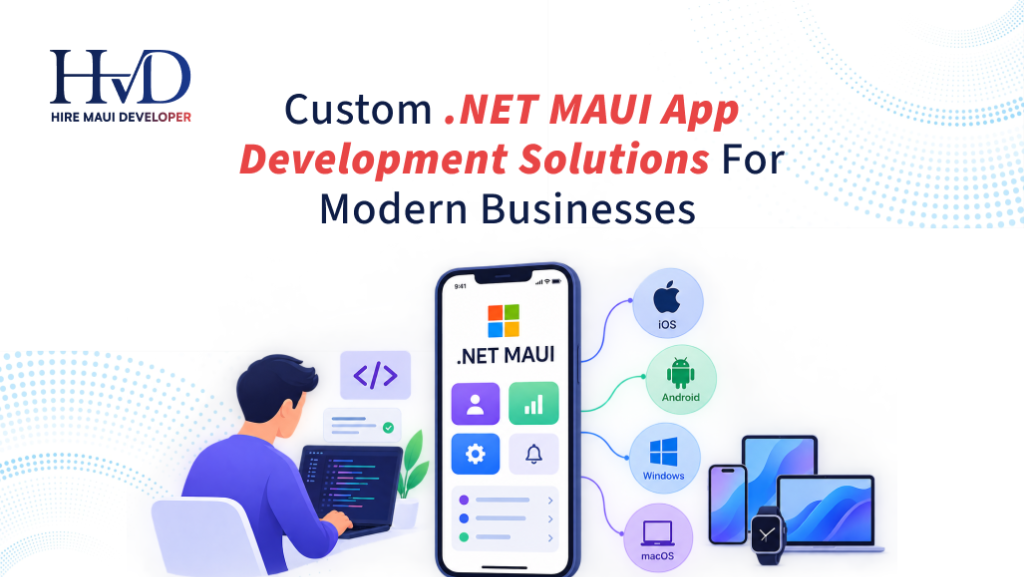
Microsoft engineered MAUI specifically to bridge this gap. The platform compiles directly into Mac Catalyst for Apple desktops and WinUI 3 for Windows machines.
You are not getting a stretched-out mobile interface on a 27-inch monitor. You get true desktop windowing. You get native menu bars, system tray access, and standard keyboard shortcut handling.
Your engineers bind the same C# view models to a mobile-optimized UI on Android, and a dense, data-rich grid UI on Windows.
This capability alone makes .NET MAUI software development services incredibly valuable for operations-heavy businesses. You train one engineering team. That team ships updates to the warehouse floor and the executive suite simultaneously.
Native Platform Handlers and Custom Hardware Integrations
Enterprise software always touches weird hardware. You need to read raw hex data from a Bluetooth environmental sensor. You need to trigger a specific Zebra thermal printer on a loading dock.
You cannot wait for an open-source hobbyist to write a plugin for your specific hardware peripheral.
The best .NET MAUI app development company will tell you the truth about hardware integration. You need a framework that lets you write raw native code when the situation demands it.
MAUI gives you an escape hatch. If a hardware vendor only supplies a native Android Java SDK, your developers can write a binding library directly in C#. They can access native platform APIs using partial classes without ever leaving Visual Studio.
This requires serious engineering talent. Before you staff your next project, review the specific maui skills required to navigate these native platform handlers. You need developers who understand how iOS handles background execution limits, not just coders who know how to center a text box on a screen.
We build custom .NET MAUI app development solutions because we can reach down into the metal whenever a client needs custom peripheral support.
Enterprise Backend Connectivity and Direct C# Sharing
Look at the server infrastructure powering your business right now.
Most established enterprises run their core operations on Microsoft Azure, SQL Server, and ASP.NET Core APIs. Your backend teams have spent years writing complex business rules, data transfer objects, and security validation logic in C#.
If you build your mobile app in Dart, Swift, or TypeScript, you have to rewrite all of those data models. You duplicate your validation logic. You spend weeks writing API documentation just so your mobile team knows what the backend team changed last Tuesday.
A .NET MAUI mobile app development company eliminates this massive source of friction.
Your mobile application shares code directly with your server. Your engineers pull the exact same class of libraries and data transfer objects into the mobile project.
When a backend developer adds a new required field to a customer's record, the C# compiler immediately flags the breaking change inside the mobile app codebase. Your team catches the error on their laptops before the code reaches a staging environment.
You move faster because the compiler enforces contracts across your entire stack.

Security, Governance, And Long-Term Maintenance Cycles
Software maintenance costs eclipse the initial build cost over a five-year lifecycle. You must plan for iOS updates, new Android permission models, and shift security standards.
Many open-source frameworks move erratically. They introduce breaking architectural changes that force your team to rewrite functioning code simply to stay compatible.
Microsoft treats .NET MAUI as an enterprise product. They align MAUI releases with the broader .NET ecosystem cadence.
You get predictable Long Term Support (LTS) releases. You can plan your upgrade cycles quarters in advance. When your Chief Information Security Officer asks for an audit of your software supply chain, you can point to Microsoft's official support policies and security patch schedules.
We provide custom .NET MAUI application development because our enterprise clients demand this level of governance. They cannot risk their entire field operations on a framework maintained by volunteers. They need corporate backing, guaranteed security patches, and a clear migration path for the next decade.
Choosing The Right Engineering Partner
Migrating a legacy application or architecting a new enterprise system requires operators who understand your business constraints.
You need an engineering partner who prioritizes your operational throughput over flashy vanity metrics. You need a team that understands how to manage SQLite databases, secure OAuth flows, and build resilient offline synchronization engines.
Talk to your developers about their QA processes. Ask them how they handle memory profiling on low-end Android hardware. Demand specific examples of how they manage state across complex multi-page data entry forms.
We focus exclusively on custom .NET MAUI app development solutions because we know how to extract maximum value from the Microsoft ecosystem. We build software that gets out of your way and lets your employees do their jobs.
Stop Funding Technical Debt
Every month you delay unifying your codebases; you burn capital on duplicate engineering efforts.
You tolerate bugs that should not exist. You delay feature releases because your Swift team finished three weeks ahead of your Kotlin team. You allow technical debt to dictate your product strategy.
Take control of your software architecture. Consolidate your engineering bandwidth. Give your team the tools they need to ship native applications to every device your business relies on.
Sarah is a veteran mobile architect specializing in enterprise .NET MAUI systems and legacy modernization. She has guided Fortune 500 logistics, healthcare, and industrial teams through complex multi-platform deployments across iOS, Android, and Windows.