Every engineering director reaches a fork in the road where two platforms promise the world. You need an app running on iOS, Android, and desktop, but you refuse to pay three different teams to build the same screens.
You run the numbers. You look at Google. You look at Microsoft.
Most software vendors tell you that the frameworks are practically identical. They show you slick slide decks, bill you by the hour, and assign whichever junior engineers happen to be sitting on their bench.
I look at this through an operator's lens. When you hire .NET MAUI developers for mobile app development, you anchor your product inside the enterprise C# ecosystem. When you hire Dart engineers, you hitch your wagon to Google's rendering engine.
Both tools produce working apps. The way they behave under actual business stress determines whether you ship features on schedule or spend your weekends patching memory leaks.
How Rendering Engines Dictate Your App Architecture
Flutter treats the mobile operating system like a dumb piece of glass.
Google built Flutter on top of Impeller, its purpose-built graphics engine. The framework does not touch native UIKit components on an iPhone or native Android widgets on a Pixel. Flutter spins up a canvas and paints every single pixel from scratch at 60 or 120 frames per second.
Buttons look identical on an iPhone 16 and a six-year-old budget tablet. For a consumer brand that obsesses over custom micro-animations, that control feels great.
.NET MAUI takes the opposite approach. It maps C# code directly to real operating system controls.
If you want to understand the plumbing under the hood, read our breakdown on what is .NET MAUI. When your developer defines a Button in XAML, MAUI uses native handlers to instantiate a true UIButton on iOS and an AppCompatButton on Android.
Your application looks and behaves like an authentic native app. Apple changes its system fonts or tweaks touch targets in an iOS update, and your app picks up those changes automatically without waiting on a third-party graphics patch.
Memory Footprints And Heavy Data Loads
Painting pixels on a canvas costs system memory. Flutter bundles an entire graphics runtime inside your binary package.
Consumer apps rarely stress that engine. A social feed displaying twenty images and three text blocks runs smooth as butter.
Enterprise internal software behaves differently. Business applications frequently handle thousands of local database records, background sync tasks, Bluetooth device connections, and dense data tables.
Shove 30,000 inventory rows into a Flutter list view. Watch Impeller chew through device RAM as it calculates bounding boxes for custom-painted shapes.
.NET MAUI handles heavy back-office computations much better. C# runs directly on the modern .NET runtime. You get raw computational speed, low-level memory allocation tools like Spans, and multithreading that does not require jumping through isolate hoops.
I saw an industrial distribution client reduce field-tablet crash rates by 42 percent simply by porting their offline sync pipeline from Dart isolates to native C# threads.

True Desktop Requirements: Windows And Mac Support
Many businesses cannot stop at smartphones. You need the exact same operational tool running on a warehouse worker's Android scanner and a manager's Windows laptop.
Flutter struggles on desktop. The community added desktop support, but apps often feel like a mobile screen stretched across a 27-inch monitor. Multi-window handling, context menus, and proper native menu bars require external community plugins that break when the Flutter SDK updates.
Microsoft built .NET MAUI with direct desktop compilation as a core goal. It compiles straight into WinUI 3 on Windows and Mac Catalyst on macOS.
You get actual desktop windows. You get native taskbar controls, authentic system tray behaviors, and standard keyboard shortcuts right out of the box.
If your roadmap includes internal teams sitting at physical dual-monitor workstations, choosing Flutter often doubles your platform glue code costs.
Backend Plumbing And Cloud Integration
Take a hard look at your current server environment before you write a single line of client code.
If your backend runs entirely on Node.js, Supabase, or Firebase, Flutter blends into your workflow. Dart syntax feels natural to web developers, and the Google ecosystem connects smoothly with modern REST services.
Most mature corporations run their core businesses on Microsoft Azure, SQL Server, and ASP.NET Core APIs.
Connecting a Flutter app to that infrastructure means writing and documenting new API endpoints for every interaction. You duplicate data transfer objects in Dart. You write data validation logic once in C# for the server and again in Dart for the mobile client.
.NET MAUI eliminates that duplicate labor. The mobile application shares class libraries, DTOs, and validation logic directly with your backend codebase.
Your engineers use the same models everywhere. When your database schema changes, the C# compiler flags the breaking change on both the server and the mobile app before the code ever leaves a developer's laptop.
The Developer Hiring Market: C# Veterans vs Dart Enthusiasts
A framework is useless if you cannot recruit competent engineers to maintain it.
The talent pool for cross-platform app developers for .NET MAUI and Flutter shows a massive split in experience and background.
Flutter attracts startups and junior developers. Dart is easy to pick up, and thousands of developers build hobby projects with it. You can post a job opening and receive 200 resumes in 48 hours, but finding engineers who understand native memory management, background services, and enterprise security policies is tough.
Teams that hire Flutter developers for cross-platform app development often struggle to find senior talent capable of fixing deep iOS or Android native build bugs.
The C# world is different. Millions of senior software engineers have spent 10 or 15 years building corporate software in .NET.
You can take an experienced C# desktop or backend engineer and train them on MAUI within three weeks. They already understand dependency injection, asynchronous patterns, and strict typing.
If you plan to recruit, check our breakdown of key .NET MAUI skills to screen applicants properly. You want candidates who understand native platform handlers, not just junior coders writing basic XAML forms.
Hardware Plugins And Third-Party Dependencies
Real business apps rarely exist in isolation. You need to connect to an external thermal printer, read an RFID tag, scan barcodes with a dedicated laser scanner, or process payments on a physical reader.
Flutter relies heavily on community packages published on pub.dev. When a package is maintained, it works.
When Google rolls out an engine update, community packages often go dead. You end up maintaining private forks of abandoned GitHub repositories just to keep your barcode scanner functioning after an OS update.
Microsoft provides long-term stability for its native hardware bindings. If a third-party vendor only provides an SDK in Java, Kotlin, Swift, or Objective-C, you create a direct binding library in C#.
MAUI lets your engineers write platform-specific code in native files directly inside the shared solution. You connect hardware SDKs provided by manufacturers without waiting for an open-source volunteer to write a wrapper.

Release Cycles And Five-Year Maintenance Costs
The initial build represents maybe 20 percent of your application's lifetime cost. The other 80 percent goes toward maintenance, OS updates, and library migrations over five years.
Google iterates Flutter aggressively. They ship breaking changes regularly. The framework moved through several rendering iterations in recent years, forcing engineering teams to refactor working software just to stay compatible with new operating system releases.
Microsoft moves at enterprise speed. They follow predictable release schedules tied to guaranteed Long Term Support (LTS) versions.
You plan your upgrade cycles quarters in advance. Your corporate IT security team gets predictable compliance roadmaps backed by an enterprise software vendor.
Deciding Between Flutter vs .NET MAUI App Development Services
Your decision hinges on your product type and your existing engineering infrastructure.
When you evaluate a .NET MAUI vs Flutter development company, look past their sales pitch and evaluate your actual operational needs.
Choose Flutter when you build a public consumer app where brand identity, custom screen transitions, and rapid visual experimentation matter most. It performs exceptionally well for consumer marketplaces, content streaming, and quick marketing prototypes.
Choose .NET MAUI when you build enterprise line-of-business applications, field service tools, inventory trackers, or healthcare portals that connect directly to Microsoft Azure and run on Windows desktops alongside mobile devices.
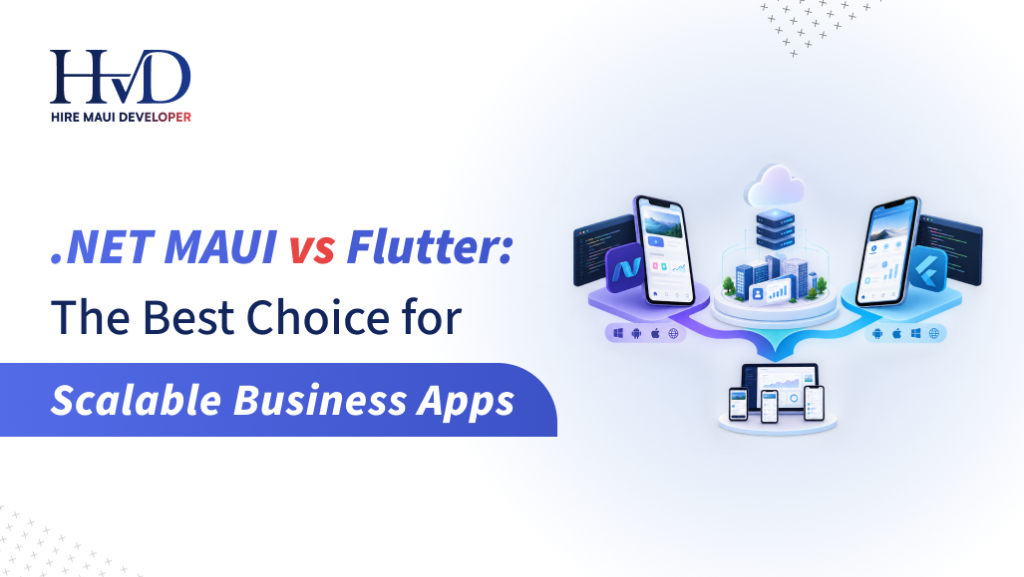
| Decision Factor | .NET MAUI | Flutter |
|---|---|---|
| UI Rendering | Native OS controls (UIKit / Android AppCompat) | Canvas-painted pixels (Impeller Engine) |
| Desktop Experience | First-class WinUI 3 & Mac Catalyst | Mobile-scaled viewports; plugin dependent |
| Backend Alignment | Direct code & DTO sharing with .NET / Azure | Separate Dart models & REST serialization |
| Heavy Data & Memory | High-throughput C# threads, memory pools, Spans | Single-threaded Dart isolates; higher RAM use |
| Talent Pool | Millions of experienced enterprise C# engineers | Large community of junior & indie developers |
| Hardware / Peripherals | Direct native C# bindings & platform handlers | Community-maintained pub.dev plugins |
| Release Stability | Enterprise LTS cadences backed by Microsoft | Fast-paced releases with frequent deprecations |
| Best Fit | Internal line-of-business, B2B & field tools | Consumer apps, media streaming & MVPs |
Make Your Architectural Call
Your team ships faster when your technology stack matches your operational reality.
If you are ready to evaluate your architecture with an experienced engineering lead, book a free consultation to review your project scope and roadmap.
Whether you need to hire .NET MAUI or Flutter developers, prioritize senior engineers who understand native operating systems over developers who only know how to assemble pre-made widgets.
If your organization runs on Microsoft technologies and requires deep data integration, our team at Hire MAUI Developer provides pre-vetted senior engineers ready to build your mobile application from day one.
Sarah is a veteran mobile architect specializing in enterprise .NET MAUI systems and cross-platform strategy. She has guided engineering teams across logistics, healthcare, and industrial operations to build high-performance mobile and desktop fleets.