Every tech founder hits this exact brick wall.
You raised your seed round. You sketched out the wireframes. Now your lead engineer is demanding a massive budget to hire two completely separate mobile teams. One guy to write Swift for Apple. One guy to write Kotlin for Google. It feels like a massive financial rip-off.
Because it usually is.
Choosing the core architecture for your mobile product dictates your burn rate for the next 5 years. Pick the wrong framework, and you will spend your entire Series A budget just keeping a basic login screen from crashing on the newest iPhone. If you want to bypass the usual agency friction, bringing in seasoned maui developers gives you a unified codebase without sacrificing native device performance.
Let us cut through the marketing noise. I want to look at exactly how native and cross-platform frameworks behave in production environments so you can make a sane financial decision.
The truth about building native right now
Native means writing code specifically for the manufacturer's operating system.
The performance is incredible. Your app talks directly to the phone's hardware. Animations run at a flawless 120 frames per second. If you are building a heavy 3D mobile game or an augmented reality visualizer that maps furniture in a living room, you absolutely must use native tools. You have zero choice.
But almost nobody is building those things.
Most B2B founders are building data grids, basic forms, and barcode scanners. Paying a premium for pure native code just to render a customer list is financial suicide. When you buy dedicated native app development services for iOS and Android, you essentially pay for the exact same business logic twice.
Your Apple developer writes a bug in the shopping cart. Your Google developer writes a completely different bug in the exact same shopping cart feature. Now your QA testing team has to track 2 separate bug tickets for a single checkout process.
It gets worse when you try to push a simple feature update. Apple approves your new iOS build on Tuesday. Google randomly flags your Android build for a policy violation and delays it until next week. Your marketing team now has to explain to half your user base why they cannot see the new dashboard.
Why founders get scammed by the dual-team trap
Software agencies love selling dual native builds. It doubles their billable hours instantly.
When you talk to a traditional native vs cross-platform app development company, watch how they pitch their services. The sales reps will inevitably bring up Facebook or Airbnb. They love telling prospects that Airbnb famously dumped React Native and went back to pure native code.
That is a terrible comparison. You are not Airbnb. You do not have 150 mobile engineers sitting on payroll.
Comparing a native app development agency vs cross-platform app development agency usually reveals a massive gap in operational thinking. Native shops want to build artisan digital products. Cross-platform shops want to solve business problems fast and get the product to market before the cash runs out.
If your company relies on a basic CRUD application (Create, Read, Update, Delete) talking to a REST API, a dual-team native approach is just vanity engineering.
The cross-platform promise and where it chokes
Write once, run anywhere. That is the dream.
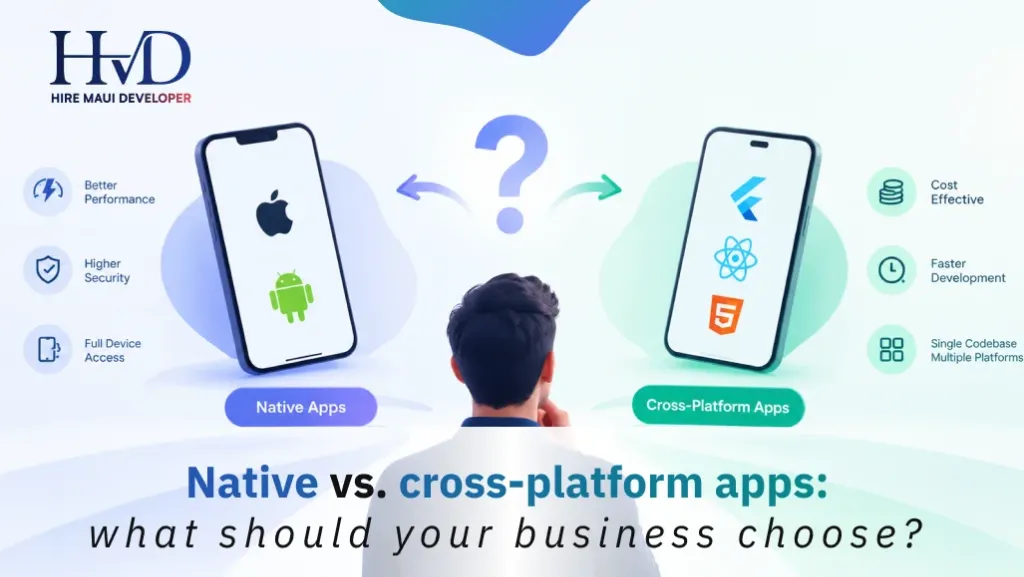
You hire 1 team. They write 1 codebase. The app magically compiles for both major app stores. For early-stage companies trying to prove product-market fit, seeking out cross-platform app development services for startups is completely logical. You literally cut your payroll in half.
But cross-platform is a massive spectrum. Some of these frameworks are total garbage.
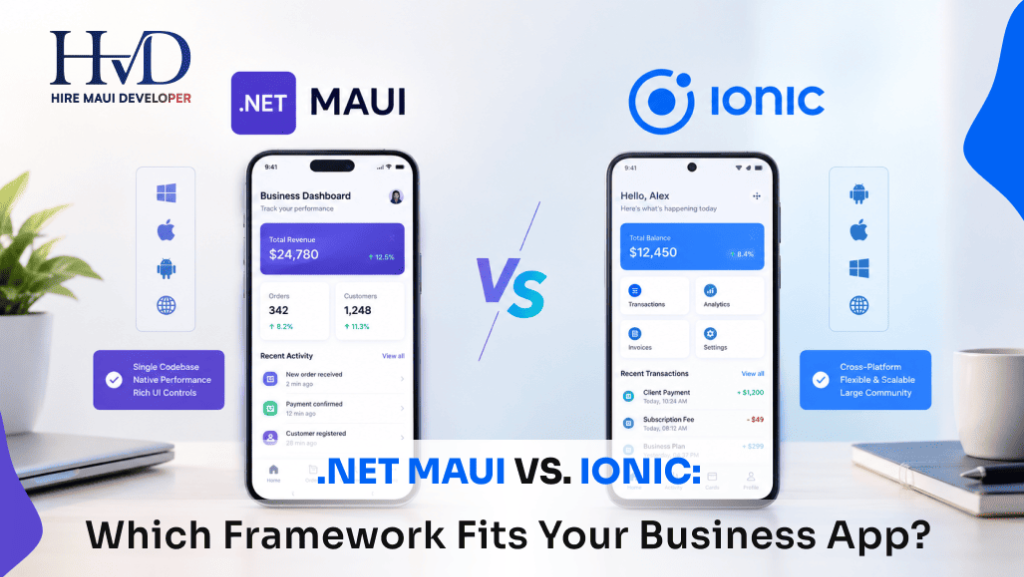
Take Ionic, for example. It is basically a website stuffed inside a hidden browser view on your phone. We did a deep technical dive into the architecture of maui vs ionic recently, and the performance differences are brutal. If you force a warehouse worker to scan 500 inventory barcodes an hour using an Ionic app, the Javascript bridge will choke. The app drops frames. The camera scanner lags. The user gets incredibly frustrated and stops using your tool.
Then you have React Native and Flutter.
Flutter is currently the darling of the startup world. It draws its own pixels on the screen using a gaming engine. It looks identical on every single phone model. That sounds amazing until you realize your iPhone users actually expect standard Apple buttons, not Google's Material Design buttons.

Why enterprise teams flock to .NET MAUI
Microsoft took a totally different approach to this problem.
Instead of drawing fake buttons on a blank canvas or stuffing a website into a browser, .NET MAUI maps your C# code directly to native UI controls. When you write a button in MAUI, the iPhone renders a real Apple UIKit button. The Samsung phone renders a real Android widget.
You get the exact performance of a native app because it literally is a native app under the hood.
If you are evaluating an app development company for native and cross-platform apps, ask them how they handle backend business logic. This is where MAUI destroys the competition.
Most enterprise companies already run their backend on C#, SQL Server, and Azure. If you build your mobile app in React Native, you have to write your validation rules in Javascript. If you build it in Flutter, you have to write them in Dart. You end up duplicating your backend logic in a completely different language.
With MAUI, you share the exact same C# classes across your backend server, your web dashboard, and your mobile app. Read our breakdown on why business consider .net maui to see how much cash this saves during a multi-year project. A single C# developer can fix a tax calculation bug in the API and the mobile app simultaneously.
We also ran heavy benchmark tests comparing .net maui vs flutter for high-traffic environments. When your app has to parse massive JSON payloads from a legacy server, C# handles the memory allocation significantly better than Dart.
Device fragmentation and the Android nightmare
Let us talk about testing for a minute.
Apple makes things easy for developers. There are maybe 10 active iPhone models in circulation. The screen sizes are standard. The processors are uniformly fast.
Android is a chaotic wasteland.
There are 15,000 different Android screen sizes. You have high-end Samsung Galaxy phones and you have $40 prepaid Motorola phones bought at a gas station. Every hardware manufacturer slaps their own custom OS layer over Android.
When you build a pure native Android app, your developers spend weeks tweaking XML layouts just so a submit button does not get cut off on a cheap tablet.
Cross-platform tools abstract that headache away. MAUI handles the weird screen density calculations for you automatically. You write a grid layout once, and the framework ensures it stretches correctly whether the user holds a massive iPad Pro or a tiny budget Android device.
CI/CD pipelines and deployment headaches
Shipping a mobile app is nothing like deploying a website.
When you update a web app, you push code to a server and users see it instantly. When you update a mobile app, you have to compile binary files, sign them with encrypted certificates, and beg Apple to approve them.
If you run two native teams, you have to maintain two completely separate DevOps pipelines. You need Mac Minis in the cloud to run Xcode build scripts for iOS. You need Linux runners for Gradle scripts on Android.
MAUI unifies this mess. You set up a single GitHub Actions or Azure DevOps pipeline. The server pulls your C# code, runs your shared unit tests once, and spits out both an .ipa file for Apple and an .aab file for Google. This cuts your DevOps engineering costs dramatically.
How to hire native or cross-platform app developers safely
Hiring tech talent is a nightmare right now.
Every bootcamp graduate with 3 weeks of React experience calls themselves a senior mobile engineer on LinkedIn. When you set out to hire native or cross-platform app developers, you have to look past the resume and test their actual architectural knowledge.
Do not ask them to reverse a binary tree on a whiteboard. That proves nothing.
Ask them how they handle offline data syncing when a user drives through a tunnel and loses 5G connectivity. Ask them how they securely store a JWT authentication token on a rooted Android device. Ask them how they profile memory leaks when a user scrolls through a list of 10,000 customer records.
Good developers talk about state management and physical hardware constraints. Bad developers just list off JavaScript libraries.
You also need to think about the long-term talent pool. Finding an iOS developer who knows Swift and an Android developer who knows Kotlin means recruiting from two completely different talent pools. Finding a C# developer is incredibly easy. C# has been a dominant enterprise language for over 20 years. Your local city is full of them.
Calculating the true cost of ownership
Founders obsess over the initial build cost. The real financial bleeding happens in year 3.
Apple and Google release major operating system updates every single fall. When iOS 19 drops, your native iOS app will probably throw a bunch of deprecation warnings. Your Android app will break because Google changed their background location tracking permissions again.
If you have two native codebases, you pay two different developers to patch those updates.
If you use a cross-platform framework, the framework maintainers handle the operating system updates for you. Microsoft updates .NET MAUI to support the new iOS features at the compiler level. You just update your NuGet packages, recompile the app, and ship it.
This drastically lowers your total cost of ownership.
Enterprise clients frequently ask us to build custom .net maui solutions specifically to escape the native maintenance trap. They want to fire their expensive external mobile contractors and hand the unified MAUI codebase over to their existing internal C# backend team. It is a brilliant financial move.

Migrating from legacy Xamarin systems
We need to address the elephant in the room for established businesses.
If your company built an app 6 years ago using Xamarin, you are sitting on a ticking time bomb. Microsoft officially ended support for Xamarin in 2024. Apple and Google will eventually stop accepting Xamarin binaries in their app stores.
You have to migrate.
You could throw the whole thing away and rewrite it in pure native Swift and Kotlin. That will take a year and cost a fortune.
Or you migrate your existing Xamarin.Forms codebase directly into .NET MAUI. Because MAUI is the direct evolutionary successor to Xamarin, you get to keep almost all of your C# business logic and view models. You just update the project structure and adopt the new Handler architecture. This is the fastest, cheapest path to keeping your legacy enterprise app alive and compliant with modern app store rules.
The final verdict on your tech stack
Do not let a developer's personal framework preference dictate your company's financial future.
Developers always want to play with the shiny new toy. They will beg you to let them rewrite your entire platform in Rust or some obscure Javascript framework that launched last Tuesday. Your job as a leader is to say no.
Your job is to pick boring, stable, predictable technology that makes your business money.
Unless your app is a high-framerate video game or heavily relies on bleeding-edge augmented reality APIs, you do not need pure native code. It is an ego purchase.
Go cross-platform.
If you run a Javascript-heavy startup, use React Native. If you run a serious enterprise shop heavily invested in the Microsoft ecosystem, use .NET MAUI. Centralize your logic. Cut your QA testing time in half. Ship features to both app stores on the exact same day.
Stop paying for the same code twice.
Sarah is a veteran mobile architect specializing in enterprise .NET MAUI systems and cross-platform strategy. She has guided engineering teams across logistics, healthcare, and industrial operations to build high-performance mobile and desktop fleets.